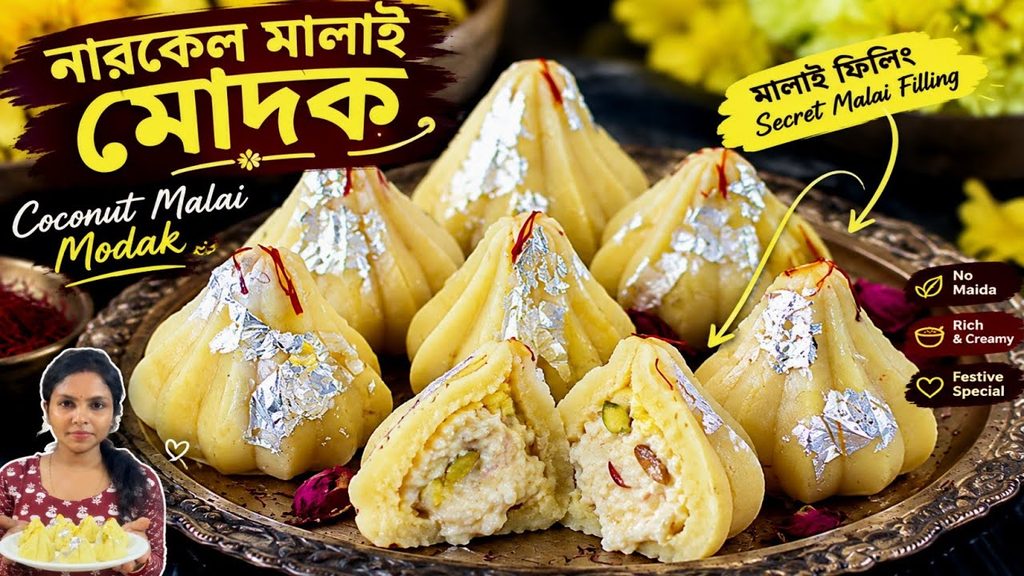
Want to make something special for Ganesh Chaturthi? Try this delicious Coconut Malai Modak Recipe from BengaliPaakshala. These homemade modaks have a soft coconut outer layer and a creamy malai-style filling made with paneer, dry fruits, milk powder, honey and saffron.
The best part? This instant modak recipe requires no mould, no condensed milk and no added regular sugar in the outer mixture. You can shape the modaks by hand and decorate them with pistachios and saffron for a festive finish.
Made with simple ingredients, these coconut malai modaks are perfect for offering as Ganesh Chaturthi prasad or serving to family and guests.
Ingredients
For the Coconut Modak Outer Layer
- ½ tablespoon ghee
- Freshly grated coconut, as needed
- ½ litre full-cream milk
- Mishri (rock sugar), to taste
- Paneer or homemade chhena made from ½ litre milk
- ¼ teaspoon cardamom powder
For the Creamy Malai Filling
- The remaining half of the paneer or chhena
- Cashews, finely chopped
- Almonds, finely chopped
- Pistachios, finely chopped
- 1 tablespoon milk powder
- ¼ teaspoon cardamom powder
- Approximately 2 tablespoons honey
- A little warm milk infused with saffron strands
For Shaping and Decoration
- A little ghee for greasing your hands
- Chopped pistachios
- Saffron strands
Note: The original recipe does not specify the exact quantity of grated coconut, mishri, or dry fruits. Adjust these ingredients according to your preferred taste and the consistency of the mixture.
How to Make Coconut Malai Modak
Step 1: Lightly Roast the Coconut
Place a frying pan over the heat and add ½ tablespoon of ghee. Spread the ghee around the pan.
Add the freshly grated coconut and sauté for approximately 30–40 seconds. Stir continuously and avoid roasting it for too long, as excessive cooking can dry out the coconut and make the modaks hard.
You can also use desiccated coconut if fresh coconut is unavailable.
Step 2: Add Milk and Mishri
Pour in ½ litre of previously boiled full-cream milk. Increase the heat and bring the mixture to a boil.
Add mishri according to your preferred sweetness. This recipe uses mishri instead of regular granulated sugar or condensed milk.
Continue cooking, stirring regularly, until the mishri dissolves and the coconut-milk mixture begins to thicken.
Step 3: Add Paneer or Chhena
Add half of the paneer or homemade chhena prepared from ½ litre of milk. Mix thoroughly to combine the ingredients.
Reduce the heat to low or medium-low. Continue stirring until the mixture becomes thick and starts coming together like a soft dough.
Step 4: Add Cardamom Powder
Add approximately ¼ teaspoon of cardamom powder and mix well.
Continue cooking until the mixture starts leaving the sides of the pan and no longer sticks easily. This indicates that the outer mixture is ready.
Transfer it to a plate and allow it to cool slightly.
Step 5: Prepare the Creamy Malai Filling
Take the remaining paneer or chhena in a separate bowl.
Add the chopped cashews, almonds and pistachios, followed by one tablespoon of milk powder and approximately ¼ teaspoon of cardamom powder.
Add around two tablespoons of honey. Pour in a little saffron-infused warm milk for colour and aroma.
Mix everything gently until the filling becomes well combined and creamy.
Important: If you are using homemade chhena, drain the whey thoroughly before preparing the filling. Excess moisture can make the mixture too soft to shape.
Step 6: Chill Both Mixtures
Place the outer coconut mixture and the prepared filling in the refrigerator for approximately 15 minutes.
There is no need to use the deep freezer. Chilling in the normal refrigerator helps both mixtures firm up, making the modaks easier to shape.
You can also divide the filling into small balls before chilling.
Step 7: Shape the Modaks Without a Mould
Lightly grease your palms with ghee.
Take a small portion of the coconut mixture and roll it into a ball. Flatten it gently and shape it into a small cup using your fingers.
Place one small ball of the creamy malai filling in the centre. Carefully bring the edges together and seal the top.
Use your fingers to create the traditional modak shape. You do not need a special modak mould for this method.
Step 8: Create the Decorative Pattern
Use the edge of a spoon to make small decorative lines along the outside of each modak.
Repeat the process with the remaining mixture and filling until all the modaks are ready.
Step 9: Garnish and Serve
Decorate each modak with chopped pistachios and a strand of saffron.
Your instant coconut malai modaks are ready to serve as a festive sweet or offer as Ganesh Chaturthi prasad.
Tips for Perfect Coconut Malai Modaks
- Roast the coconut briefly: Too much roasting can dry out the mixture.
- Drain the chhena properly: Excess water makes shaping difficult.
- Cook the outer mixture until thick: It should come together like a soft dough and leave the sides of the pan.
- Chill before shaping: Refrigeration helps the mixture become firmer.
- Grease your hands lightly: A little ghee makes shaping easier.
- Adjust sweetness carefully: Mishri and honey provide sweetness, so add them according to your taste.
- Use saffron and pistachios for decoration: They give the modaks a beautiful festive appearance.
Frequently Asked Questions
Can I make modaks without a mould?
Yes. You can shape them by hand and use a spoon to create decorative lines.
Can I make coconut malai modaks without condensed milk?
Yes. This recipe uses milk, mishri, coconut and paneer instead of condensed milk.
Can I use store-bought paneer?
Yes. Store-bought paneer can be used, provided it is fresh and has been drained well if needed.
How long should I refrigerate the mixture?
Approximately 15 minutes in a regular refrigerator is suggested in this recipe. The exact time may vary depending on the moisture content and temperature.
Can I use desiccated coconut?
Yes. Desiccated coconut can be used instead of freshly grated coconut, although the texture may differ.
Make these delicious coconut malai modaks for Ganesh Chaturthi and share your experience in the comments.
For more festive sweets, traditional recipes and easy homemade cooking ideas, follow BengaliPaakshala.